Substations are where electricity lines are connected and switched and where the voltage is changed by transformers. They range from the very large to the very small - see below for a guide. But in nearly all cases, the highest field is usually produced by the lines and cables supplying the substation and not by the equipment inside the substation itself. If the substation itself produces a field outside its perimeter, it usually falls away over the first few metres.
We give more detail of the fields from different types of substations. In each case click on the link for more details of the field it produces.
National Grid substations
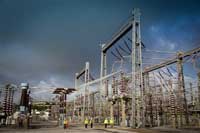 These are large substations where 400 kV and 275 kV lines are switched and electricity is transformed down to the next voltage, 132 kV.
Sealing End Compounds
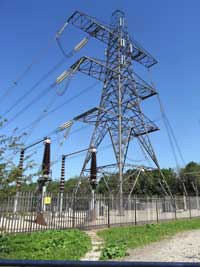 A sealing end compound is where an overhead line joins on to an underground cable. It looks a bit like a small substation, surrounded by a metal fence, but does not contain any transformers or switchgear.
Intermediate substations
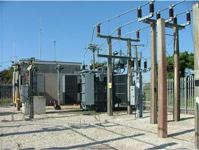 These are like National Grid substations but smaller and transform electricity between 132 kV, 33 kV and 11 kV. They produce fields in a similar way to a National Grid substation, only generally at a lower level reflecting the lower voltages and smaller sizes.
more details
Final distribution substations
These transform the electricity from (usually) 11 kV to the voltage used in the home, 230 V. See more details of the magnetic field they produce. They come in different types:

 Indoor - built into a small building which may look like a garage, or as part of a bigger building. The clue is the safety sign on the door. This is the one type of substation which can sometimes give markedly raised magnetic fields beyond its own confines.
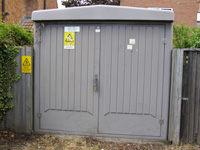 Cabinet - built into a fully-enclosed cabinet.
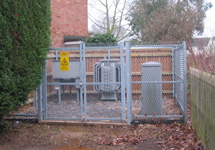 Outdoors - the separate components are mounted on the ground and enclosed by a metal or wooden fence.
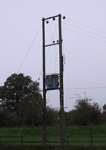 Pole-mounted - the transformer is raised above ground on a wood pole.
Numbers of substations in the UK
The following table gives numbers of substations in the UK published in 2011:
Substation Type | Typical Voltage Transformation Levels | Approximate number nationally | Typical Size | Typical Number of Customers Supplied | |
| Grid | Grid Supply Point | 400kV to 132kV | 380 | 250m by 250m | 200,000/500,000 |
| Bulk Supply Point | 132kV to 33kV | 1,000 | 75m by 75m | 50,000/125,000 | |
| Primary | 33kV to 11kV | 4,800 | 25m by 25m | 5,000/30,000 | |
| Distribution | 11kV to 400/230V | 230,000 | 4m by 5m | 1/500 | |
In addition there were 349,000 pole-mounted 11 kV/400 V transformers.
source: ENA Adaptation to Climate Change First Round Report under the ARP, Electricity Transmission and Distribution Network Companies, 23 April 2011
To avoid confusion:
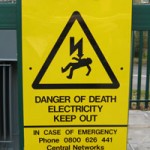 Substations and pylons carry warning notices warning of the dangers of electrocution - this is nothing to do with EMFs.