This page deals with high-voltage underground cables. Underground cables at lower voltages are covered in the pages on distribution.
4% of the high-voltage electricity network in England and Wales is underground, mainly in urban areas or areas of great scenic beauty.
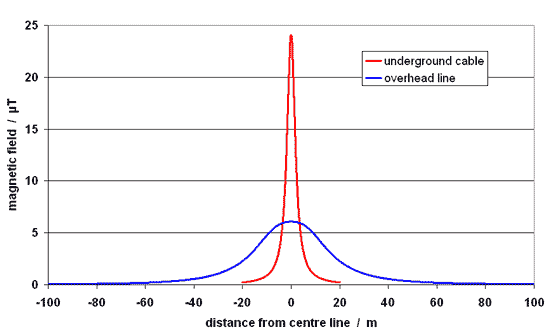
With underground cables the individual conductors, being insulated, can be closer together, leading to greater cancellation and lower fields. However, unless they are buried very deeply, they can also be approached more closely, leading to higher fields. Overall, ground-level magnetic fields from underground cables fall much more rapidly with distance than those from a corresponding overhead line, but can actually be higher at small distances from the cable.
The graph shows an illustration of this for one particular underground cable and the equivalent overhead line.
Different types and voltages of underground cables
Cables at different voltages
See graphs and tables of fields produced by underground cables at different voltages:
400 kV | 275 kV | 132 kV | 66 kV | 33 kV | 11 kV | 400 V
Cables in tunnels
Occasionally, instead of being buried directly in the ground, an underground cable is placed in a tunnel, which can be 20 or 30 metres below ground. In this instance, the conductors cannot be approached closely by members of the public, and the magnetic field at the surface is much reduced, lower than an equivalent overhead line and often lower than background fields from other sources. More on the different types of high-voltage underground cable.
Cables with multiple conductors
Often, underground cables have two circuits (matching the two circuits of an overhead line) laid in the ground fairly close together, and sometimes each circuit may need to have two groups of conductors. See how these multiple groups of conductors affect the magnetic field.
Single-phase cables
Most high-voltage cables are three-phase, but with railway supplies you sometimes get single-phase cables. The fields are broadly comparable but see fuller details.
Gas Insulated Lines
A newer technology, not yet used in the UK, is Gas Insulated Lines (GIL). These produce lower magnetic fields because there are return currents in the sheath that partially cancel the magnetic field.
Other issues with fields from underground cables
Height above ground
Fields from underground cables are very sensitive to the height above ground.
Screening of underground cables
Underground cables, whether directly buried or in a tunnel, produce no external electric field. Screening of the magnetic field is possible but unusual.